The IVES Update Newsletter is a highly informative monthly e-newsletter. It contains up-to-date industry information, regulatory updates, stories from the field, upcoming program dates, What’s Wrong With This? photos, incident reports, our interactive “Ask Bob” question and answer column, new product details and much more.
Whether you're interested in forklifts, mobile elevating work platforms, loaders or excavators – we’ve got you covered. Want to receive it directly to your inbox? Sign up for our IVES Update e-Newsletter!
Year:
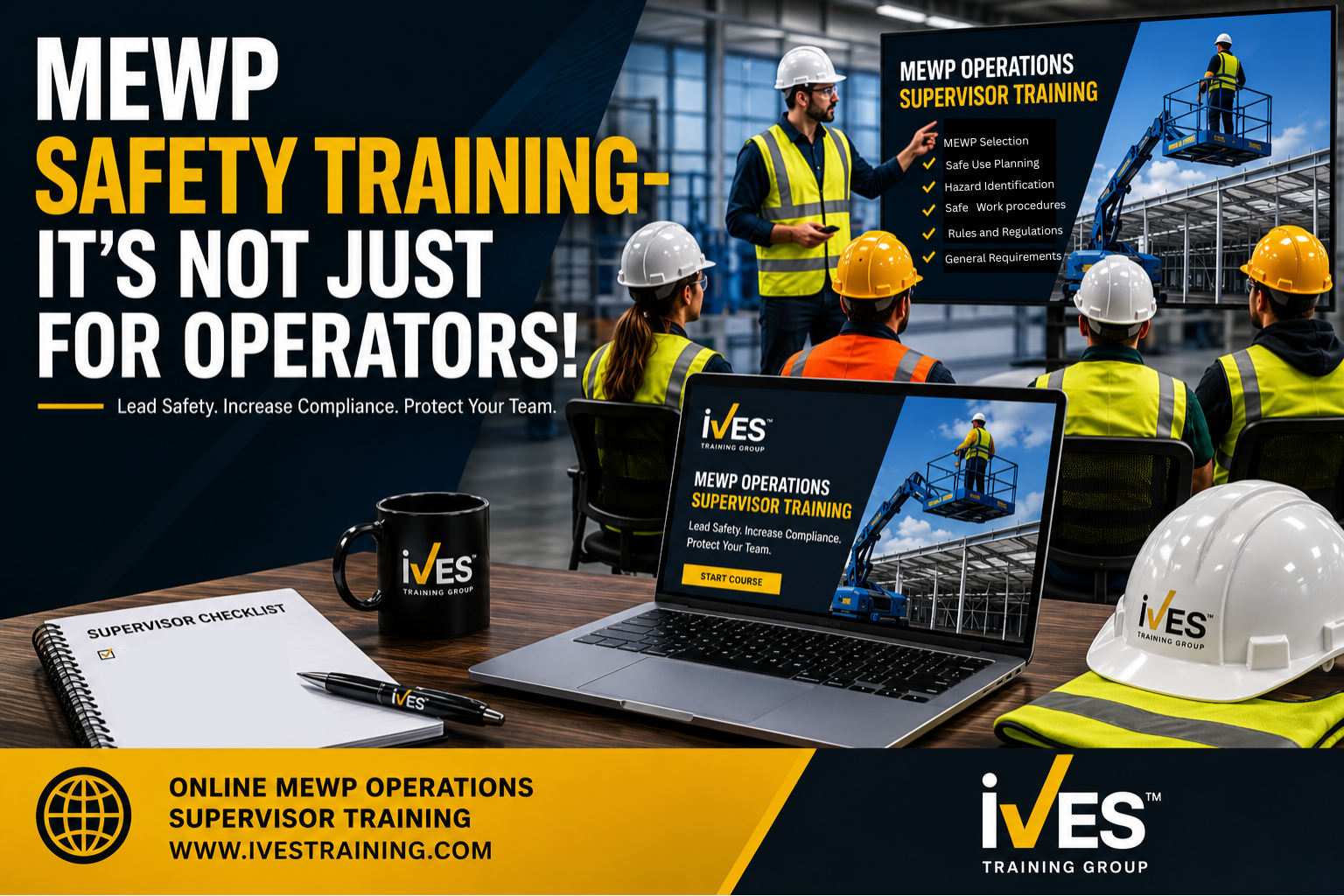
If you’re a regular reader of the IVES Update or follow us on our social media feeds, including Facebook and Instagram, you probably know that we now offer an online Mobile Elevating Work Platform (MEWP) Operations Supervisor Program. What you may not know is, why?
The short answer is, it’s required. The long(er) answer, which addresses questions such as, who requires it, what it involves, how long it takes and more.
First, who requires MEWP Supervisor Training? The American National Standards Institute (ANSI). Specifically, Section 7.5 of ANSI/SAIA A92.24 – 2018 Training Requirements for the Use, Operation, Inspection, Testing and Maintenance of Mobile Elevating Work Platforms (MEWPs), which calls for personnel that “directly supervise” MEWP operations to be trained.
In the U.S.A., enforcement of ANSI A92 standards is a bit tricky because neither the Occupational Safety and Health Administration (OSHA) nor State OSH regulations reference them in any way that makes compliance with them mandatory. However, those same OSH regulations do contain general duty requirements which can be applied to situations for which OSH regulations are lacking or do not exist. For clarity, lets look at the most common iteration of general duty wording, OSHAs General Duty Clause (Sec. 5(a) (1) of the OSH Act), which states:
Each employer shall furnish to (its) employees employment and a place of employment which are free from recognized hazards that are causing or likely to cause death or serious physical harm to (their) employees.
A key element within this requirement is the term “recognized hazards.” While most people think it means recognition of a hazard within a given workplace, by the personnel in that workplace, its scope is much broader than that. In reality, OSH regulators and, by extension, legal authorities and representatives, regularly accept hazards identified or addressed within credible, well-established industry standards, like the aforementioned ANSI A92 standards, to be industry recognized hazards. So, even though a given standard may not be incorporated by reference into OSH regulations, compliance with the standard can be enforced through general duty citations, particularly when the following criteria are met:
- The employer failed to keep the workplace free of a hazard to which employees of that employer were exposed.
- The hazard was recognized.
- The hazard was causing or was likely to cause death or serious physical harm.
- There was a feasible and useful method to correct the hazard.
In Canada, the Occupational Health and Safety (OHS) framework is somewhat different. Part II of the Canada Labour Code contains OHS regulations that apply only to federal workers, which is about 6% of Canada’s workforce, with the remaining majority falling within provincial or territorial OHS jurisdiction. Canada is also home to the Canadian Standards Association (CSA Group) that, like ANSI, distributes MEWP-related safety standards.
Compliance requirements with CSA / ANSI standards are a bit simpler in Canada as, in most cases, the OHS regulations of each jurisdiction reference them directly, making compliance mandatory. Some jurisdictions reference only the CSA standards while others reference both CSA and ANSI as acceptable. This creates a bit of a wrinkle in that the CSA standards contain no requirements for MEWP supervisor Training.
However, Canada has very robust regulatory and legal requirements addressing the direct duties and responsibilities of supervisors, not the least of which are ensuring worker safety and compliance with OHS regulations. Canada also has federal, criminal legislation known as the Westray Act that holds anyone “directing the work of others” criminally liable for workplace deaths and injuries. With this sort of legal framework in place, Canadian supervisors of MEWP operations are well advised to get the training they need to help them fulfill their responsibilities, regardless of what industry standards do or do not require. As a wise trainer once told me, if you’re a cop, it’s hard to enforce the speed limit if you don’t know what it is.
The good news is that our online MEWP Operations Supervisor Program is here to help. It covers everything you need to know, it’s affordable and it only takes a couple of hours at the most to complete. And let’s not forget, it could save lives!
Throughout my career in the industrial safety arena, people have often asked me what I thought the most significant factor is in ensuring the success of in-house safety programs and training was. My answer has always been, supervisor training. Front line supervisors who are aware of not just regulatory requirements but the contents of the safety training the workers on their crew receive are light years ahead in terms of their ability to monitor the safety of workers and correct unsafe behaviors they observe. This ensures that safe work procedures learned and demonstrated during worker training continue beyond the classroom and into the everyday work environment where they become ingrained in the work habits of employees and the safety culture of the company.
We all know the importance of MEWP operator training as well as the time, effort and expense involved in making it happen. Employers can maximize the positive effects of their efforts and investment by making sure supervisors have the specific knowledge they need to lead MEWP operations in today’s modern workplaces.
Rob Vetter – Director of Training – IVES Training Group
 A fatal backover at a southwestern Ontario construction site has cost two parties a combined $145,000, in a case that underscores the persistent danger of operating heavy equipment without a signaller.
Following guilty pleas in Sarnia Provincial Offences Court, Justice of the Peace Daniel Peter Michael Byskal fined 1838107 Ontario Ltd. — a Watford farming corporation and constructor operating as Agro Acres — $130,000, and contractor Nick De Jong, operating as De Jong Excavating, $15,000.
A 25 per cent victim fine surcharge applies to each penalty.
The charges stem from a May 9, 2024 incident at a project on Churchill Lane in the Township of Warwick. A worker was carrying out demolition and construction tasks around a barn while, the Ministry of Labour, Immigration, Training and Skills Development reported, "regular farm and mechanical shop operations continued on site."
Several workers and multiple pieces of heavy equipment were operating nearby, with "no clear separation between work activities."
The worker had been directed to retrieve steel rebar near an operating front-end loader. As the operator reversed — "looking over their right shoulder" — they did not see the worker approaching from the left. The collision was fatal.
The ministry investigation found the operator's view was obstructed and that no signaller was used. The loader also had a "missing or misaligned mirror." Investigators concluded that Agro Acres "failed to ensure that a signaller was provided where required," and that De Jong failed to ensure he was assisted by a signaller under those conditions.
Agro Acres pleaded guilty under section 25(1)(c) of the Occupational Health and Safety Act for failing to carry out measures prescribed by section 104(3) of Ontario Regulation 213/91, the Construction Projects regulation. De Jong was convicted as a worker under section 28(1)(a) for failing to comply with the Act.
Source: The Safety Mag - June 2026
 "The pace of the class was great and very engaging."
Josh H, Premium Combo Trainer Certification
"Instructor was great and extremely knowledgeable. He was also great at making complex topics easy to understand."
Devin G, Custom Program Trainer Certification
"This was a great program. How it was instructed was beyond what I was expecting from all of this."
Chris R, Express Standard Forklift Trainer Certification
 Q: Hi Bob,
What the requirements for the annual inspection and the CSA's special inspection for a telehandler?
A: The “special” inspection you are referring is something I usually equate with MEWPs (aerial lifts), I am not aware of any CSA requirements for a special inspection in relation to telehandlers.
However, I can certainly help with the annual inspection.
This can be found in the CSA B335-15 standards.
You can register and view them for free.
There are no specific NDT requirements for telehandlers as outlined in the CSA standards or the manufacturer operators/service manuals.
However, there are some basic annual inspections required.
The standard is copyrighted, so I can’t quote exactly what it says here but when you look it up online, check out Section 8 where the requirements for regular planned maintenance and inspections are detailed.
Some of the highlights include:
- They must be carried out by trained and qualified personnel and in accordance with the requirements listed in the manufacturer’s operations manuals.
- They include regular planned maintenance and annual planned maintenance.
- If the manufacturer does not specify a time interval for the above actions, they must happen every 200 operating hours for regular and every 2,000 hours for annual.
- A load test to ensure the unit can lift the load capacity listed on the data plate has to be conducted when you first get it and at least annually after that.
As said earlier, I’m not quoting the exact words from the standard here so be sure to access and view it online.
copyright © IVES Training Group 2022 All Rights Reserved.