The IVES Update Newsletter is a highly informative monthly e-newsletter. It contains up-to-date industry information, regulatory updates, stories from the field, upcoming program dates, What’s Wrong With This? photos, incident reports, our interactive “Ask Bob” question and answer column, new product details and much more.
Whether you're interested in forklifts, mobile elevating work platforms, loaders or excavators – we’ve got you covered. Want to receive it directly to your inbox? Sign up for our IVES Update e-Newsletter!
Year:
In this issue, we will be covering:
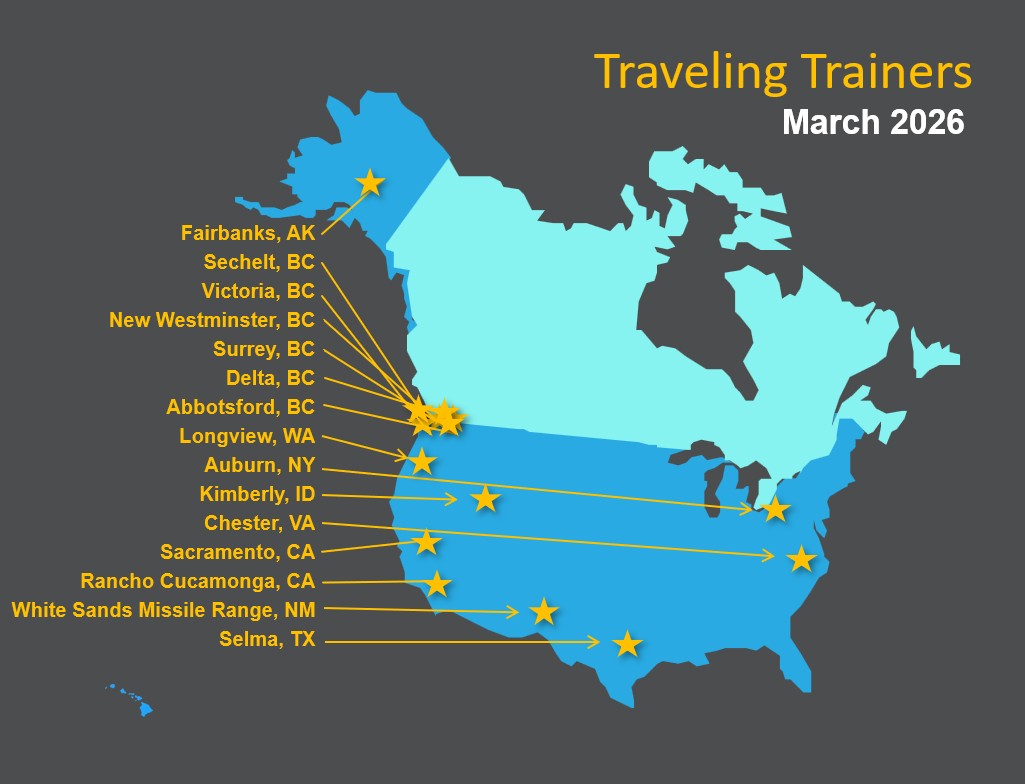
But first, check out all the places we are delivering training this month...
Telehandlers – Machines in Search of an Identity
Rough terrain variable reach forklifts, also known as telescopic material handlers or simply, telehandlers, have been around in one form or another for nearly 70 years. Prototypes of “reaching forklifts” first appeared in Europe in 1957 while machines with similar designs showed up in the US around 1959. By the late 1970s, what we would recognize today as modern telehandlers, were well on their way to becoming the omnipresent industry staples they are today.
The popularity of telehandlers across so many market segments from general industry to construction, to agriculture and beyond, is due to the many capabilities their design and functionality make possible. It’s hard if not impossible for other equipment types to match their power, adaptability, operating range and ability to navigate and operate on unimproved, rough terrain surfaces. When you add the fact that numerous work attachments are readily available to handle a diverse range of tasks including material handling, personnel elevating, load hoisting and even earthmoving applications, you begin to understand - telehandlers appear to be in a class by themselves. Which brings us to what has become a bit of an issue in the industry lately, which begs the question, what exactly is a telehandler?
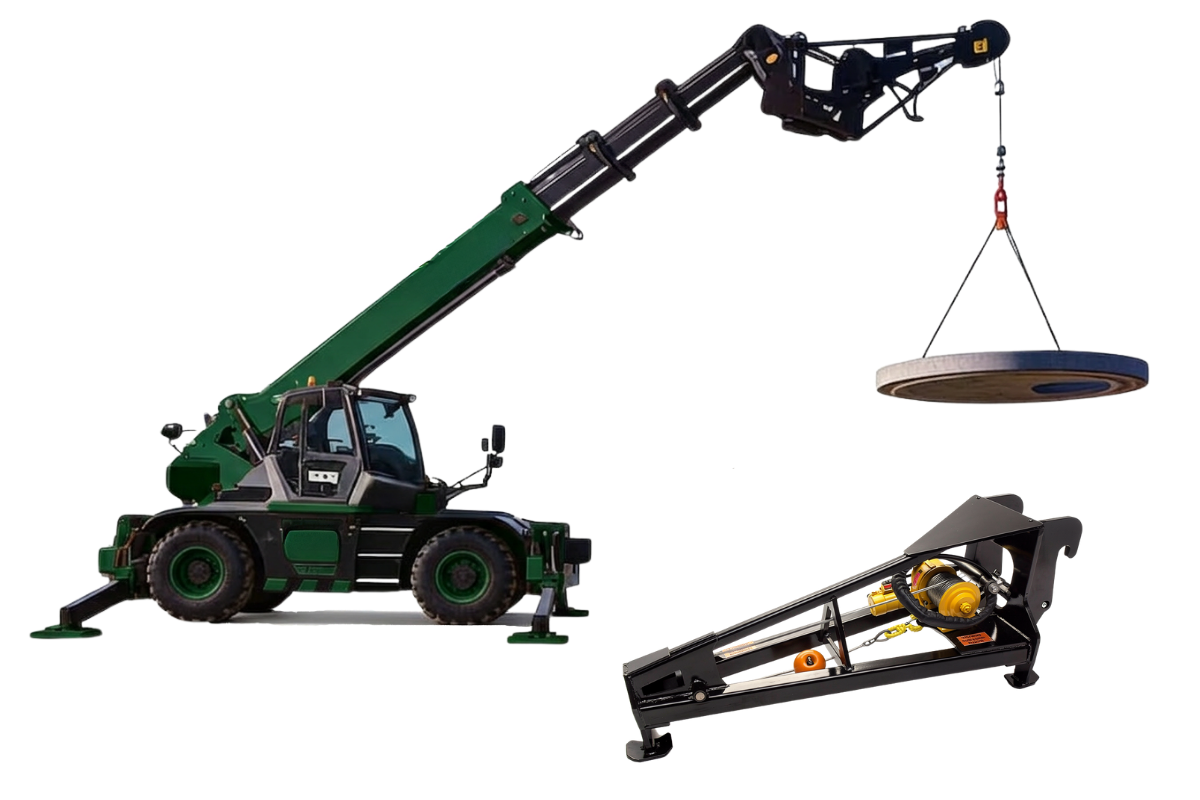
Since the industry standards we are required to comply regarding the design, construction and safe use of telehandlers, being ANSI B56.6 and CSA B335, are both forklift standards, the answer may seem simple, a telehandler is a forklift. This is sound logic, but only as long as it’s being used as a forklift and was mentioned earlier, it can be used for so much more. Remember, you can strap on any number of specialty work attachments to a telehandler, many of which can potentially, and significantly, affect the interaction between the load and the machine and, by association, how the machine is operated. In fact, there are many who argue that certain attachments not only affect how the machine is used, but the identity of the machine itself. For example, a telehandler fitted with a personnel elevating platform is no longer a forklift, it’s a mobile elevating work platform (MEWP). One fitted with a material bucket is now an earthmover and one fitted with a crane attachment, is now a mobile crane. From this perspective, the identity or classification of the equipment is not determined as much by its design as it is by its applied use.
This raises issues, not the least of which is operator training. If a telehandler is being used for tasks that fall outside the typical material handling tasks commonly associated with forklifts, then it follows that operators must receive specific training in how to perform those atypical tasks safely. This is especially important when crane operations with telehandlers are among those tasks because in most cases, the operators performing them need to be certified as crane operators.
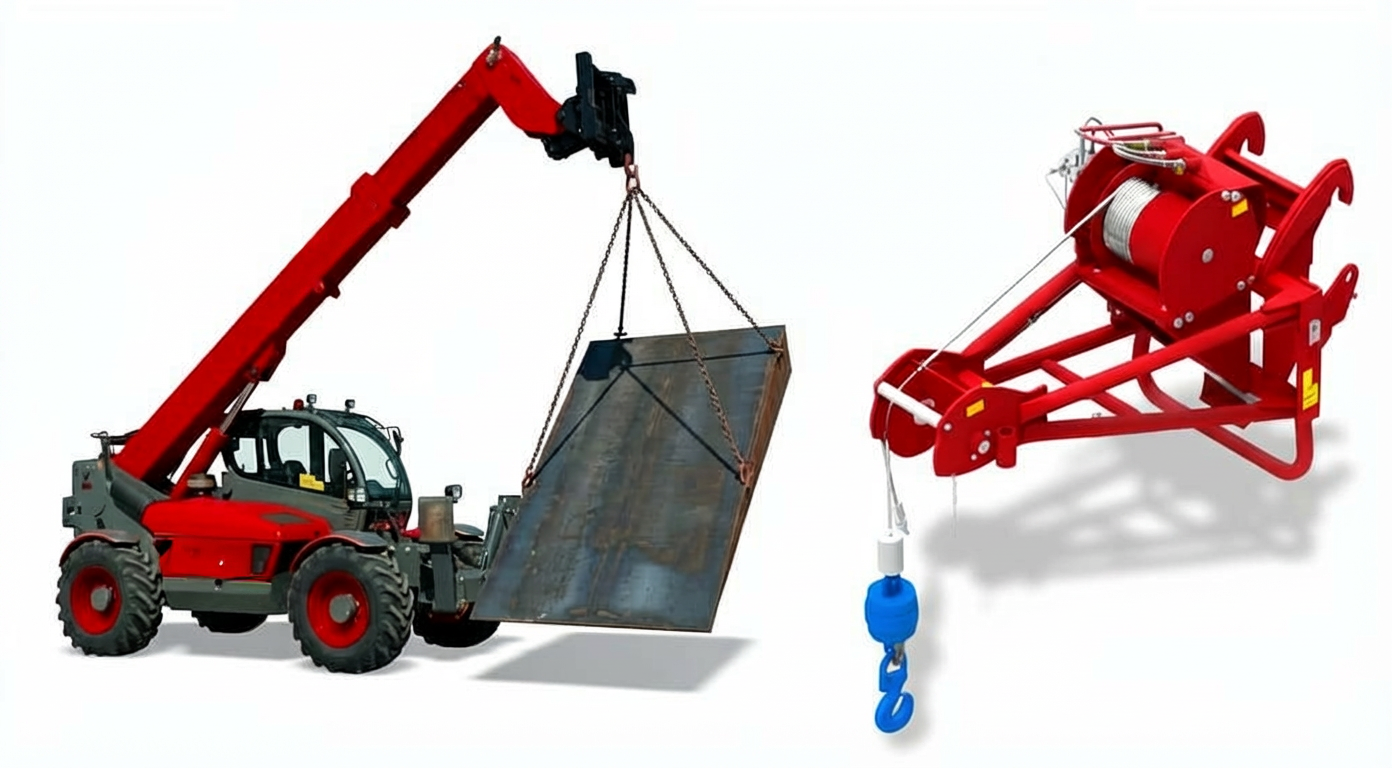
When exactly a forklift becomes a crane in the eyes of regulatory agencies throughout North America vary. However, the following criteria is widely accepted across most regulatory jurisdictions that a forklift may be defined as a crane if it:
- Is equipped with a boom and powered hoist (winch/drum).
- Engages the load from above using a hook or sling attached to rigging.
- Can raise and lower a load vertically without moving the mast/boom.
- Can move a suspended load horizontally.
Free rigging, which involves using chains or slings laid across the forks to engage and carry a load from above usually does not trigger crane operator training requirements as long as no powered hoist, which seems to be the single most significant element in defining a forklift as a crane, is used. In addition, many regulatory jurisdictions require the written approval of the manufacturer and/or a proper engineering assessment prior to free rigging operations.
It must also be noted that some regulatory agencies are not as picky as this and simply state that if a forklift is being used as a crane, then it’s a crane, regardless of whether it is a telehandler, vertical mast forklift or what attachment is used. In fact, some of those same regulatory bodies refer to telehandlers, particularly rotating telehandlers, as “multi-use lifting equipment” rather than forklifts. This points out their reluctance to consider them simply as forklifts, especially when they are configured for crane work.
In any case, specific work requires specific training and if where you are, that work involves craning, you really should consider having certified crane operators to do it.
General Notes:
- The International Organization for Standardization (ISO) publishes several standards containing specific information on the design, construction and safe use of rotating (slewing) telehandlers, including:
 A waste and recycling company has been fined after an employee suffered life-changing injuries after being crushed by a telehandler.
Sheridan Skips Burnley Limited was handed a £24,000 fine after their employee Jordan Campion was crushed against a wall by a reversing telehandler on 12 March 2024.
The 21-year-old was sorting and separating material by hand along with three co-workers at the Smiths Yard site, on Clifton Street, when the telehandler reversed into him.
Mr Campion suffered multiple fractures, nerve damage to his right arm, and internal organ injuries. He also lost partial hearing in his right ear and permanent sight loss in his right eye.
He was in hospital for nearly two weeks following the crash.
In his victim personal statement, Mr Campion said: "My incident has caused my family great distress. They permanently worry about me; they never thought that I wouldn't be safe in work.
"They say you never expect to see your child go off to work and to get a phone call to say that they have had an incident and might not survive."
An investigation by the Health and Safety Executives (HSE) found that Sheridan Skips Burnley Limited had not properly assessed the risks that come with having employees working alongside vehicles.
There was also no physical protection from moving vehicles, such as barriers.
The investigation also found that the telehandler was missing mirrors making it impossible for the driver to see clearly while reversing.
Sheridan Skips Burnley Limited, of Cathedral Gates, Manchester, pleaded guilty to breaching Section 2(1) of the Health and Safety at Work etc. Act 1974.
The company was fined £24,000 and ordered to pay £4,777 in costs at Blackburn Magistrates' Court on 11 March.
After the hearing, HSE inspector Anthony Banks said: "This young man's injuries could so easily have been avoided with the implementation of safe working practices, including pedestrian and vehicle segregation and safe refuges for workers whilst vehicles were operating.
"These measures would have ensured that workers present in the yard were not put at risk of being struck by vehicles moving in and around where they were working.
"This should serve as a reminder to businesses operating in the waste industry to ensure that workplace transport is appropriately considered, with control measures introduced to ensure the appropriate separation of vehicles and pedestrians."
 Q: As a qualified trainer of Standard Forklifts and Rough Terrain Telehandlers, am I qualified to train others on narrow aisle lifts, and if not, what would be required.
A: Your current IVES trainer credentials do not include narrow aisle forklifts.
You need to either attend a Premium Forklift Trainer Certification Program or a Custom Upgrade Program to upgrade your current credentials to include the narrow aisle equipment.
You can contact the office and speak to one of our program coordinators for options.
 "IVES” “Train the Trainer” was an extremely beneficial program to undertake and expand my knowledge as a safety professional."
Zach R, Premium Combo Trainer Certification
"I have been an IVES instructor for over 17 years. IVES has been an industry leader and continues to improve training programs."
Alex K, Premium Forklift Trainer Certification
"I felt the training provided a good balance of the written material, training aides and hands-on experience."
William D, Premium Combo Trainer Certification
copyright © IVES Training Group 2022 All Rights Reserved.