
The IVES Update Newsletter is a highly informative monthly e-newsletter. It contains up-to-date industry information, regulatory updates, stories from the field, upcoming program dates, What’s Wrong With This? photos, incident reports, our interactive “Ask Bob” question and answer column, new product details and much more.
Whether you're interested in forklifts, mobile elevating work platforms, loaders or excavators – we’ve got you covered. Want to receive it directly to your inbox? Sign up for our IVES Update e-Newsletter!
Year:
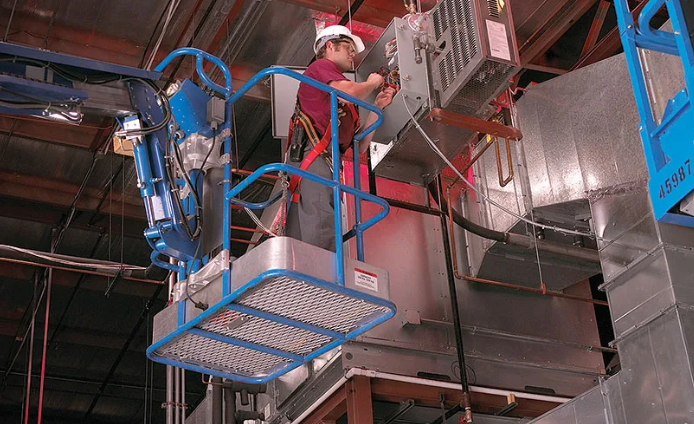
Aerial lifts are routine fixtures across construction, manufacturing, healthcare, and oil and gas sites, but crews sometimes treat pre-lift precautions as optional. Most incidents stem from the same preventable violations. Closing these gaps can reduce avoidable risk.
Workers enter the basket without a harness and lanyard attached to the boom, or tie off to an adjacent structure instead of the manufacturer-designated anchor point. This often happens during quick punch-list work or when someone needs to grab a tool they missed. They decide the task doesn't seem worth the hassle of a proper tie-off.
Rushed schedules, uncomfortable harnesses and inconsistent enforcement across shifts all contribute to this violation. Operators usually understand the requirement but rarely expect anyone to enforce it. This points to a culture issue around consistent enforcement.
Fall protection general requirements remain OSHA’s most frequently cited standard for FY2025. It indicates industry-wide blind spots. Between 2011 and 2014, 87 workers died operating an aerial or scissor lift. Slips, trips and falls caused 48 of those deaths.
To avoid this violation, build tie-off verification into the pre-lift checklist. Run toolbox talks around near-miss patterns and treat noncompliance as an immediate stop-work trigger.
An available employee hops in the basket to speed up a job even though they lack formal authorization or certification. When a crew runs short-handed, a supervisor might let a worker who's watched someone else operate the lift operate it to keep the schedule moving.
Untrained operators are more likely to miss early warning signs, like uneven ground, overhead lines or shifting loads. They also tend to misjudge the lift's stability limits. What starts as a time-saving shortcut can quickly turn into a serious incident.
One solution is the National Institute for Occupational Safety and Health's Aerial Lift Hazard Recognition Simulator. It gives operators a way to practice identifying hazards, such as falls, crushing points, electrocution risks and tip-over conditions, before they encounter them on a live site.
Another measure you can implement is to document and refresh authorization status on a set cadence for each location and equipment type. Remove the assumption that they carry over between jobsites and machinery.
Crews reduce pre-shift inspections to a quick visual glance or skip them entirely when running behind schedule. An operator might notice a hydraulic leak during a rushed walk-around. They decide it's probably fine for one more day without removing the unit from service.
This violation can happen even on well-run sites when inspection responsibility is unclear. The equipment owner, the rental provider and the workers using it that day all share this ambiguity.
Workers aren't always trained on exactly what a thorough inspection should cover beyond the basics. Plus, many teams now rely on rental aerial lifts, which can create confusion over who verifies a machine's condition before anyone operates it.
Rental companies that document and verify machine condition before it reaches the site removes a major point of failure from your team's plate. A few examples of what this looks like in practice:
When a two-person crew loads extra materials into the platform to avoid a second trip up, the combined load can exceed the posted limit. People, tools and supplies quickly add up. Workers often don't realize that the additional cargo pushes them past the machine’s rated capacity.
Capacity ratings often remain buried in manuals without visible posting on the machine. Teams rarely calculate total load once one factor, like headcount, seems within range.
This isn't an isolated lift-specific quirk but part of a broader OSHA load-bearing principle. OSHA applies specific load-bearing requirements to scaffolding, including support for its own weight plus at least four times the anticipated load. For aerial lifts, the safer comparison is capacity discipline. Crews must follow the manufacturer’s rated basket and boom limits rather than treating the platform as extra material storage.
Post capacity ratings directly on the control panel. Require a quick tally before ascending and build supervisor spot-checks into routine site walks to avoid this violation.
Crews leave outriggers retracted, fail to set brakes or operate the lift on sloped or uneven ground without wheel chocks. A crew might position the machine on what appears to be level pavement near a loading dock. They fail to account for a slight grade that shifts the lift's center of gravity once the boom extends.
Full stabilization can feel unnecessary for quick jobs. Ground conditions that look stable don't always reveal soft spots, slopes or debris until crews extend the lift. Many crews know outriggers and brakes matter, but skip the full process when a job feels low-risk.
Avoid this offense by requiring a documented ground assessment before every use. Make outrigger and brake checks a nonnegotiable line item on the pre-lift checklist. You can also have supervisors walk tight or sloped sites before work begins.
Here are the answers to common questions about aerial lift safety and compliance.
Process failures drive these violations. Ensure your crews don’t skip steps under time pressure and clarify accountability for checks. Closing these gaps requires consistent enforcement of what your teams already know. Walk through each violation against your current site practices and address the weakest link first, and move forward from there.

Maintaining our copyright has been an ongoing concern since company’s inception back in 1981.
Through the years, some of our clients have experienced what they feel is the need to copy IVES’ training materials.
Some, contact us and ask beforehand, and we appreciate that as often, they have legitimate needs and we can help them. However, most do not ask, nor do they have legitimate reasons for copying.
Today, in this digital age where so much can be downloaded and saved with just a few clicks on a computer keyboard, there seems to have developed a pervasive attitude that copying things at will is OK. However, when it comes to the training materials that are the life blood of our company, it most certainly is not.
Every unauthorized copy of our Operator Theory Tests, Practical Evaluation forms, or Operator Reference Manuals not only violates the law but could potentially lead to liability in that such material may be outdated and possibly inaccurate.
This makes things very difficult if not impossible to support or defend under the often-intense scrutiny of regulatory or legal representatives during the investigations and possible litigation that may follow serious workplace safety incidents.
We update our materials on an ongoing basis to ensure they remain compliant with ever-developing occupational safety and health regulations, industry safety standards and best practices. We also keep them up to date with modern powered mobile equipment operational features and technical specifications developments.
Please respect our proprietary materials. By partnering with us for official, up-to-date resources, you ensure your team receives accurate training while supporting ongoing innovation.
Don’t let a hurried or poor decision to copy leave you exposed to potentially costly legal consequences or worse, human tragedy. Stay current and on the right side of the law – don’t copy!
The IVES Team October 2026 A construction and tools supplier has been fined £137,000 following a Hillingdon Council investigation into an incident where an employee suffered injuries after being struck by a forklift truck.
Mills Limited, which operates from Zodiac Business Park, Cowley, Uxbridge, was sentenced at Isleworth Crown Court on Wednesday 16th September after pleading guilty to two offences under the Health and Safety at Work etc Act 1974 at Uxbridge Magistrates' Court on 14th July.
The council’s health and safety officers were notified of a serious incident at the company’s warehouse on 13th September 2024 when a forklift truck collided with an employee. The collision caused them to fall and hit the back of their head on the floor, leaving them unconscious. They required hospital admission and after care.
The council received a statutory accident notification on 20th September and began an investigation. Officers reviewed questionnaire responses and health and safety documentation and carried out a site visit on 4th October to assess workplace conditions.
The investigation found that the company had failed to put effective controls in place to keep pedestrians separate from vehicle operations. It also identified a number of other safety failings, including a lack of designated walkways and exclusion zones, restricted visibility for forklift truck operators, and poor management of vehicle movements within the warehouse and yard.
The company’s risk assessments from 2023 had already identified concerns about forklift truck movements and pedestrian safety, and recommended measures such as better segregation, warning signage, and tighter controls around loading and unloading activities.
CCTV footage from 6th September, a week before the incident, also showed a near miss involving a pedestrian and a forklift truck at the site, highlighting recurring risks.
The council subsequently served an Improvement Notice on 25th October requiring the company to strengthen its workplace transport safety arrangements, including better segregation between vehicles and pedestrians, reviewed risk assessments and introducing additional controls and monitoring measures.
When sentencing, the judge took into account that the company had self-reported the incident, actively engaged in the investigation, and introduced a range of improvements in line with the notice, including designated pedestrian routes, additional barriers, upgraded signage and lighting, refresher forklift truck training and banksman training for staff.
Mills Limited was ordered to pay a fine of £118,000, a victim surcharge of £2,000 and £17,000 towards the council’s prosecution costs.
Councillor Adam Bennett, Hillingdon Council’s Cabinet Member for Community, Environment and Enforcement, said: “Businesses have a legal duty to protect the health and safety of their employees, visitors and anyone else who may be affected by their activities.
“This case highlights the serious consequences that can arise when workplace safety risks are not properly addressed, especially when large vehicles and machinery are involved.
“Our environmental health officers play an important role in ensuring businesses comply with the law and take the necessary steps to prevent harm. We will not hesitate to take action where serious failures are identified.’’
West London Herald September 2026 Q: Hi Bob,
One of our trainers has a question regarding Operator Certification Numbers during requalification training.
If a trainer conducts requalification training for an operator who was originally qualified by a different trainer three years prior, should the Operator Certification Number be updated?
A: To make this the easiest way to remember, I like to say it like this and apply it as needed.
"He/She who worked with the operator last gives out the number. "
If the operator was trained previously by them and requalified under them, they are still the same trainer so no new number is issued/they keep the same number.
If another trainer trained them previously and then you requalify them, you worked with them last so you give out the new number. That way, it always ties back to the trainer that worked with them last.
 "I learned so much from this class, a lot of which I thought I knew but really didn’t. Best instructor I’ve come across in a long time."
Joe H, Premium Combo Trainer Certification
"Excellent throughout & professional. IVES is the gold standard."
Andrew D, Custom Program Trainer Certification
"This was by far one of the most educational and engaging classes I have ever attended."
Gabriel S, MEWP Trainer Certification
copyright © IVES Training Group 2022 All Rights Reserved.

